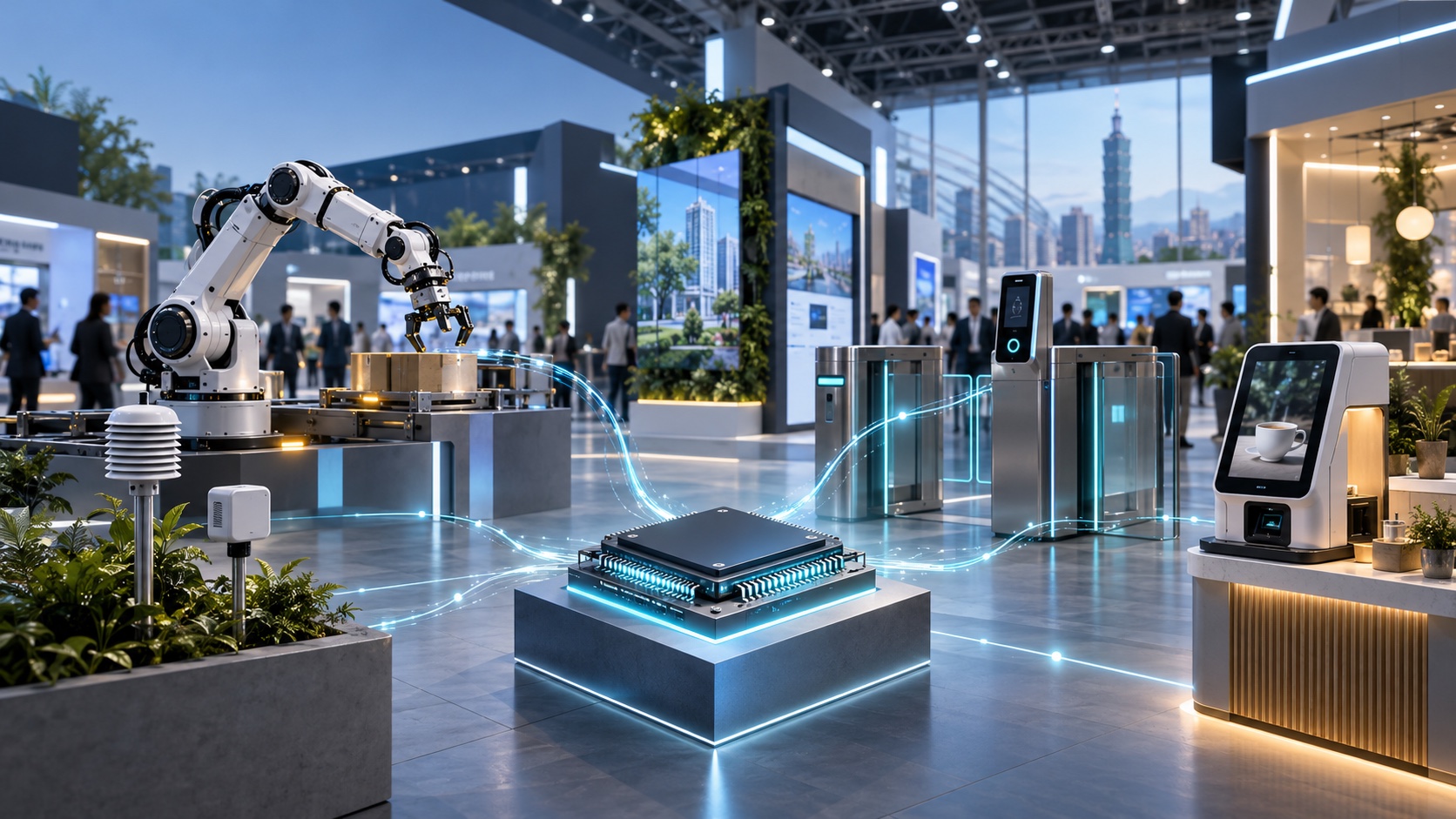
Over the past few years, Cellbedell has often been recognized as a provider of smart hospitality and access control solutions.
We help hospitality operators enable unattended check-in, let visitors enter spaces with digital keys, and give businesses more efficient ways to manage offices, meeting rooms, and shared facilities.
For us, however, smart hospitality has always been a starting point, not the end of our technology journey.
The more fundamental question we continue to work on is this:
How can identities, permissions, and instructions in the digital world be safely translated into actions in the physical world?
As AI Begins to Understand the World, What Enables It to Act Safely?
Generative AI is evolving from a tool that answers questions into AI agents that can plan tasks, call systems, and coordinate work.
But new challenges emerge when those tasks extend beyond computer screens into buildings, equipment, and physical spaces.
For example:
When an AI agent books a meeting room for a visitor, can it also arrange the appropriate access permissions?
When an unattended commercial space needs to operate automatically, can AI coordinate equipment, identity, and access management?
When a robot needs to enter another floor or a restricted area, what determines whether it has the appropriate authorization?
These are not simply questions about the capabilities of an AI model.
They involve identity verification, permission management, device communication, and safe execution in physical environments.
AI can propose an action, but the physical world needs a trustworthy mechanism to decide which actions may be carried out.
This is the direction Cellbedell continues to pursue.
From Virtual Key to Edge Computing
At the core of Cellbedell's technology is a virtual key and edge verification architecture, rather than a conventional access control device alone.
Virtual Key enables systems to deliver digital identities and access permissions to different people or application services.
With devices such as NU1 Edge and NU1 Bioedge, permissions can be verified on the device, without requiring an immediate response from the cloud for every operation.
This design provides several important capabilities:
- Digital Identity: Manage identities and access permissions through digital credentials.
- Edge Verification: Verify authorization on the device.
- Offline Capability: Continue operating during a network outage, provided the authorization conditions are met.
- API Integration: Connect physical devices with different software platforms and services.
To us, hardware is more than a reader. It is a trusted execution endpoint connecting digital authorization with physical action.
Cellbedell Nexus: Enabling AI to Collaborate with Physical Spaces
As our applications expand, we are further developing Cellbedell Nexus.
Nexus serves as an infrastructure layer between AI, application services, and edge devices.
It integrates an API Gateway, Permission Engine, Device Management, and interfaces to third-party systems, allowing services to access physical resources in a consistent, controlled way.
In this architecture, an AI agent does not need to operate each access control device directly.
AI can submit a task request; Nexus checks and coordinates authorization, and edge devices verify it and execute the action.
We summarize the process as:
AI Proposes → Nexus Authorizes → Edge Verifies → Physical World Acts
This is more than an automated workflow.
It establishes clearer permission boundaries and execution mechanisms between AI and the physical world.
Beyond Buildings: From Smart Spaces to Physical AI Infrastructure
Today, Cellbedell's applications extend beyond hospitality.
Corporate offices, shared spaces, smart libraries, and unattended commercial facilities have similar needs:
A person or system must determine who may use a resource, when it may be used, and how devices should respond.
As AI agents increasingly participate in these decisions, this infrastructure will become more important.
In the future, AI may not only understand the state of a building, but also help coordinate space resources, visitor journeys, and device operations.
Cellbedell aims to provide the technical foundation that makes these interactions possible safely.
We do not believe every building needs to become a fully autonomous AI system.
But we believe that spaces capable of collaborating with AI must first have trustworthy digital identity, permission management, and edge execution capabilities.
That is why we continue to invest in Virtual Key, Edge Computing, and Cellbedell Nexus.
Building the Infrastructure for an AI-Connected Physical World
Smart hospitality has helped us demonstrate how digital authorization can change the way physical spaces are used.
Smart buildings have extended this technology to more devices and management scenarios.
The rise of AI agents now points to the possibilities of the next stage.
We are moving from helping people enter spaces more conveniently toward enabling AI to interact with the real world under appropriate authorization.
Cellbedell is evolving from a Smart Building OS toward AI-Ready Physical Infrastructure.
Our goal is not to give AI direct control over the physical world. It is to build trustworthy infrastructure that allows intelligence to become action safely.
Cellbedell — Connecting AI Intelligence to the Physical World.
Meet Us at TAITRONICS & AIoT Taiwan 2026
Explore the Future of AI and Physical Spaces with Us
From smart hospitality to AI-Ready Physical Infrastructure, Cellbedell continues to explore how AI can collaborate safely with the physical world.
This year, our hardware technology partner Nestech (聯騏技研) will present the following solution at the Industrial Development Administration pavilion at TAITRONICS & AIoT Taiwan 2026:
Edge AI-Powered Autonomous Commercial Space Management Solution
邊緣 AI 無人商用空間管理方案
The demonstration will show how Cellbedell's virtual keys, edge computing technology, and Nexus infrastructure can be integrated to help businesses build smarter, safer unattended commercial spaces that are ready for AI integration.
Whether your focus is smart buildings, unattended operations, AI agents, or physical device integration, we welcome you to visit and exchange ideas.
Exhibition Details
TAITRONICS & AIoT Taiwan 2026
- Dates: October 20–22, 2026 — exhibiting all three days.
- Venue: Taipei Nangang Exhibition Center, Hall 1.
- Location: Industrial Development Administration, Ministry of Economic Affairs, pavilion J0102.
- Exhibitor: Nestech (聯騏技研).
- Exhibit theme: Edge AI-Powered Autonomous Commercial Space Management Solution (邊緣 AI 無人商用空間管理方案).
October 21 Special Event: 晶片賦能・創新產品分享會
Alongside the exhibition, we will participate in the chip-enabled innovation and product sharing session, 「晶片賦能・創新產品分享會」, on October 21 to discuss how edge computing connects smart devices with unattended commercial space management.
- Date: Wednesday, October 21, 2026.
- Event time: 15:30–16:30.
- Nestech presentation: 16:15–16:25.
- Presentation topic: Edge AI-Powered Autonomous Commercial Space Management Solution.
- Venue: Industrial Development Administration pavilion J0102, Taipei Nangang Exhibition Center, Hall 1.
All times are Taiwan time (UTC+8).
Let's Connect!
The future of AI is not limited to screens. It extends into the physical world.
We warmly welcome system integrators, technology developers, smart building professionals, and partners interested in AI agents and intelligent physical applications from around the world.
Join us to explore how Virtual Key × Edge Computing × Cellbedell Nexus can bring AI from digital intelligence into the real world.
Visit us at the Industrial Development Administration pavilion J0102, October 20–22!
Cellbedell — Connecting AI Intelligence to the Physical World.